Science
Related: About this forumRheumatic Fever Is An Autoimmune Syndrome Leading to Heart Disease: Strep Throat and Antibiotic Access.
Over the years, I've used my access to the scientific literature to help friends and family to understand major health issues. As I have lived a long life with few major health problems, I've never had to do it for myself: Until now.
My mother was one of ten children who lived to adulthood - an additional three died as children from unknown causes. Several of my aunts who reached adulthood, and my mother, all had various degrees of heart disease, in each case it valvular, and as I was growing up, the etiology was described to me - in decidedly non-scientific terms as resulting from "rheumatic fever." Three of my aunts died from this form of heart disease.
I'm an old man now, and kind of smug in offhand ways about assuming things about health family history, only finding out years after the fact, at least apocryphally, the truth about probable cause of fatal diseases. For example, I mused nervously that my mother's death by a brain tumor elevated my own risk, only to find out, decades later, that the cause was occupational; the plant where she worked is now a superfund site, and the sister of a coworker (my cousin) told me lots of people in the plant were getting brain tumors. Thus, similarly, I relied, lazily, on my glib assumption that "rheumatic fever" was the result of a specific type of specific pathogenic, but rare organism and that everyone faced a risk of the disease that was now treated by antibiotics.
The paper to which I'll refer, is a review article referring to a genetic disposition toward valvular heart disease such as the aortic stenosis, which I apparently may have and for which I am being evaluated with a rising series of tests. It is this one: Muhamed, B., Parks, T. & Sliwa, K. Genetics of rheumatic fever and rheumatic heart disease. Nat Rev Cardiol 17, 145–154 (2020). It is a rather detailed paper, and I will not have time to discuss it in any depth, but it is interesting, and probably relevant to my own case, as I had several episodes of strep throat in my youth, and in one case, it took several days for me to find someone to drive me to a doctor to get a prescription for antibiotics. While I have access to the full paper it is, regrettably behind a firewall for the general public. At the time I was poor.
When I was a young man, one of the main foci of our party, the Democratic Party, was addressing poverty, not only here in the United States, but all over the world. This focus has receded to an uncomfortable sense, but, as we are sinking into third world status under the weight of racism, ignorance, contempt for science, erosion of medical care, etc. it is perhaps relevant to consider it, as the pathogenic organisms and viruses come home to roost.
From the introduction of the paper:
RHD remains a public health priority in low-income and middle-income countries, despite being nearly eliminated from high-income countries5,6,7,8,9,10. In 2005, approximately 471,000 cases of RF were estimated to occur annually, of which 336,000 were in children aged 5–14 years11. Current global estimates suggest that, in 2015, 33,194,900 patients were living with RHD in RHD-endemic countries, whereas there were only 221,600 affected individuals in non-endemic countries12. The total disability-adjusted life-years lost to RHD globally in the same year was estimated to be 10.5 million12. The highest age-standardized mortality from RHD occurs in Oceania, south Asia and central sub-Saharan Africa12..
The role of genetic susceptibility in developing RF and RHD has been highlighted in familial studies and in the observation of different clinical outcomes after GAS infections16,17. The unexplained predisposition to RHD among certain individuals in the population suggests a genetic contribution to the condition18. In this Review, we assess the emerging role of genome-wide association studies (GWAS) in RHD research, outlining both the advantages and disadvantages of this approach. We also highlight the potential use of large-scale, publicly available data sets and the opportunity for large-scale collaborative studies, which are substantially more likely to produce findings that have ramifications for clinical practice.
A combination of risk factors can influence susceptibility to GAS, RF and ultimately RHD (Fig. 1). The risk of developing RHD is likely to be defined by an interaction between GAS infections, such as streptococcal pharyngitis, the socioeconomic status of the patient and community, access to primary health care and genetic susceptibility1,17,19.
I bolded the parts about poverty.
A figure from the text:
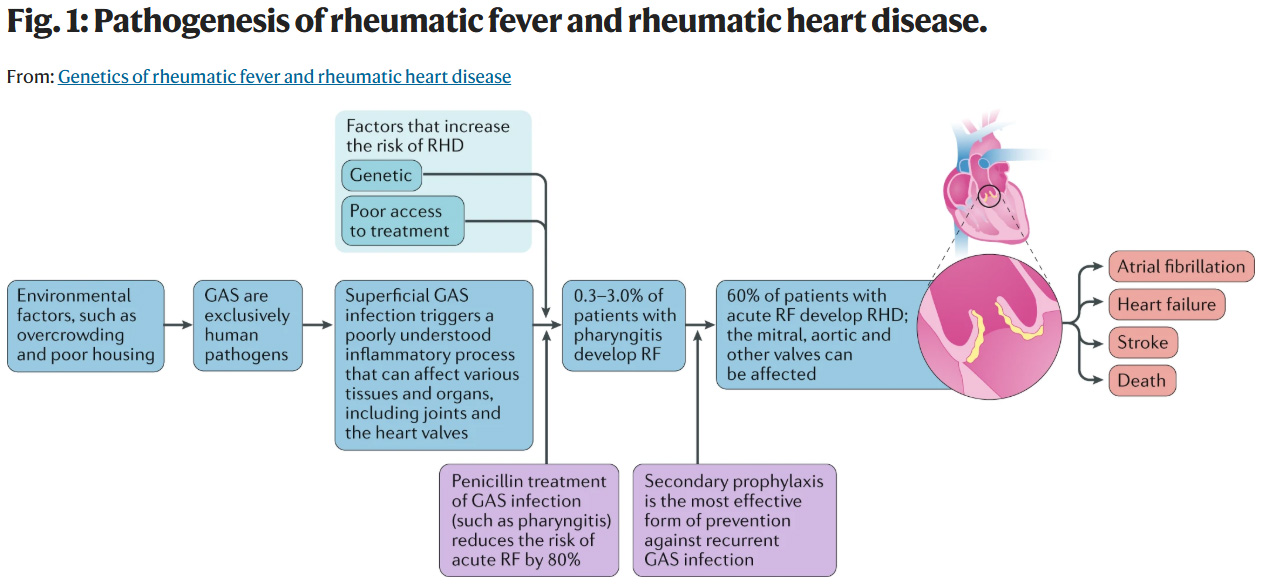
The caption:
Even though I'm an old man, who has lived a long and finally happy life, the two bottom outcomes on the right side, in orange, the color of the dementia stricken pedophile in the White House, are scary. (I'm looking into the stroke risk associated with one treatment for this disease. It's not entirely reassuring.) I recognize that I'm not immortal, but facing mortality with a specific cause in mind is unsettling.
More text:
Family-based studies offer an important starting point in genetic epidemiology through which the genetic determinants of a trait of interest can be assessed24. Familial aggregation can be defined as the occurrence of a disorder at a higher frequency in relatives of affected persons than in the general population, attributable to genetic and/or environmental factors25. If established, familial aggregation might indicate genetic inheritance, aggregation of risk factors or a gene–environment interaction related to the disease26,27.
Early studies describing RF and RHD recognized the frequent occurrence of multiple cases in the same household or family28,29. As early as 1889, Cheadle noted that the risk of RF in an individual with a family history of the disease was nearly fivefold greater than that of an individual with no family history16.
Check on that one, my dead aunts.
A little further on:
Since the 1980s, several investigators have linked specific human leukocyte antigen (HLA) markers to susceptibility to RF and RHD. Initially, this association was on the basis of serological typing using the two-stage microcytotoxicity method32. Later, with the inception of molecular methods, this approach was superseded by methods based on sequence-specific primers32. From the 1990s onwards, molecular methods became the preferred HLA typing method.
HLA genes are found within the major histocompatibility complex on chromosome 6, a complex region of the genome containing ~260 genes and spanning ~4 Mb (ref.33). The role of the HLA molecules themselves is to bind peptides and present them to receptors on T cells, but the locus also contains numerous other immune-related genes with a variety of functions.
The authors discuss GWAS analysis (Genome-wide association studies) to identify the genes:
There have been multiple studies, the limitations of which are small sample sizes, but the suspect genes, according to the paper are thought to be on chromosome 6, coding for the HLA (Human Leukocyte Antigens), however, a highly correlated gene has been found in Melanesian populations on chromosome 4:
Researchers are combing through the data of the commercial company 23andMe to get more insight. (The company does not exist to really tell you about your family history and whether you are descended from the awful British Royal Family with genes from Wales or northern Germany. It exists to sell medical data related to susceptibility genetic diseases, so pharmaceutical company's can decide on which diseases to invest in.)
Cool, or disturbing. I'm not Melanesian, of course, but I now believe I have some problem genes in any case.
I have been advised medically to limit my activities until after the completion of a series of tests. I regret I will not be able to participate in NO KINGS protests today, but my heart, defective as it may be, is with those who go.
Oh, if you know a young person suffering from strep throat, or for that matter, an old person, and there is a family history of this sort of thing, get them to a doctor fast.
Have a good time at NO KINGS, if you can and do go, and a wonderful weekend beyond that.
 = new reply since forum marked as read
Highlight:
NoneDon't highlight anything
5 newestHighlight 5 most recent replies
= new reply since forum marked as read
Highlight:
NoneDon't highlight anything
5 newestHighlight 5 most recent replies

delisen
(7,357 posts)I had rheumatic fever as a child and was subsequently diagnosed with valve damage. However unlike you I have had a number of other auto-immune conditions.
I am happy for you that you have had good health.
I will read the article you cited.

quaint
(5,066 posts)

NNadir
(38,003 posts)...with valve replacement procedures.